mirror of
https://github.com/zdharma-continuum/zinit-annex-bin-gem-node.git
synced 2026-09-10 07:26:18 -04:00

551 lines
20 KiB
Markdown
551 lines
20 KiB
Markdown
# zinit-annex-bin-gem-node<a name="zinit-annex-bin-gem-node"></a>
|
||
|
||
<!-- mdformat-toc start --slug=github --maxlevel=3 --minlevel=2 -->
|
||
|
||
- [Installation](#installation)
|
||
- [How it works](#how-it-works)
|
||
- [Ices](#ices)
|
||
- [sbin](#sbin)
|
||
- [Usage](#usage)
|
||
- [Example](#sbin-example)
|
||
- [Bypass parsing RC config files](#sbin-bypass-rc)
|
||
- [sbin vs. lbin](#sbin-vs-lbin)
|
||
- [fbin](#fbin)
|
||
- [gem](#gem)
|
||
- [node](#node)
|
||
- [pip](#pip)
|
||
- [fmod](#fmod)
|
||
- [fsrc](#fsrc)
|
||
- [shim-list](#shim-list)
|
||
- [Cygwin Support](#cygwin-support)
|
||
- [Example](#example-6)
|
||
|
||
<!-- mdformat-toc end -->
|
||
|
||
A Zsh-Zinit annex (i.e., an extension) that provides functionality that allows:
|
||
|
||
1. Run programs and scripts without adding anything to `$PATH`,
|
||
1. Install and run Ruby [gems](https://github.com/rubygems/rubygems), [Node](https://github.com/npm/cli), and
|
||
[Python](https://python.org) modules from within a local directory with
|
||
[$GEM_HOME](https://guides.rubygems.org/command-reference/#gem-environment),
|
||
[$NODE_PATH](https://nodejs.org/api/modules.html#modules_loading_from_the_global_folders) and
|
||
[$VIRTUALENV](https://docs.python.org/3/tutorial/venv.html) is automatically set,
|
||
1. Run programs, scripts, and functions with automatic `cd` into the plugin or snippet directory, plus also with
|
||
automatic standard output & standard error redirecting.
|
||
1. Source scripts through an automatically created function with the above `$GEM_HOME`, `$NODE_PATH`, `$VIRTUALENV`, and
|
||
`cd` features available,
|
||
1. Create the so-called `shims` known from [rbenv](https://github.com/rbenv/rbenv) – the same feature as the first item
|
||
of this enumeration – of running a program without adding anything to `$PATH` with all of the above features, however
|
||
through an automatic **script** created in `$ZPFX/bin`, not a **function** (the first item uses a function-based
|
||
mechanism),
|
||
1. Automatic updates of Ruby gems and Node modules during regular plugin and snippet updates with `zinit update …`.
|
||
|
||
## Installation<a name="installation"></a>
|
||
|
||
Load like a regular plugin, i.e.:
|
||
|
||
```zsh
|
||
zinit light zdharma-continuum/zinit-annex-bin-gem-node
|
||
```
|
||
|
||
After executing this command, you can use the new ice mods provided by the annex.
|
||
|
||
|
||
## How it works<a name="how-it-works"></a>
|
||
**Note:** The README is somewhat outdated – the `sbin''` ice that creates forwarder scripts (shim) instead of
|
||
forwarder-functions (created by the `fbin''` ice and elaborated in this `How it works …` section) turned out to be the
|
||
proper, best method for exposing binary programs and scripts. You can jump to the `sbin''` ice
|
||
[section](#5-sbingncneopath-to-binary---name-of-the-script-) if you want or read on, as the forwarder-scripts are pretty
|
||
similar to the forwarder functions elaborated on in the following text:
|
||
|
||
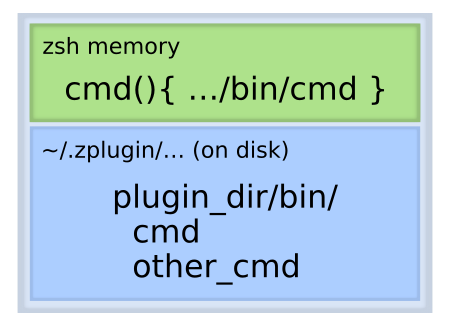
Below is a diagram explaining the major feature – exposing a binary program or script through a Zsh function of the same
|
||
name:
|
||
|
||
|
||
|
||
This way, there is no need to add anything to `$PATH` – `zinit-annex-bin-gem-node` will automatically create a function
|
||
that will wrap the binary and provide it on the command line as if it were placed in the `$PATH`.
|
||
|
||
Also, as mentioned in the enumeration, the function can automatically export `$GEM_HOME`, `$NODE_PATH`, `$VIRTUALENV`
|
||
shell variables and also automatically cd into the plugin or snippet directory right before executing the binary, and
|
||
then cd back to the original directory after the execution is finished.
|
||
|
||
Also, as already mentioned, instead of the function, an automatically created script – so-called `shim` – can be used
|
||
for the same purpose and with the same functionality, so that the command is accessible practically fully and normally –
|
||
not only in the live Zsh session (only within which the functions created by `fbin''` exist) but also from any Zsh
|
||
script.
|
||
|
||
Suppose that you want to install the `junegunn/fzf-bin` plugin from GitHub Releases, which contains only a single file –
|
||
the `fzf` binary for the selected architecture. It is possible to do it in the standard way – by adding the plugin's
|
||
directory to the `$PATH`:
|
||
|
||
```zsh
|
||
zinit ice as"command" from"github-rel"
|
||
zinit load junegunn/fzf-bin
|
||
```
|
||
|
||
After this command, the `$PATH` variable will contain, e.g.:
|
||
|
||
```zsh
|
||
% print $PATH
|
||
/home/sg/.zinit/plugins/junegunn---fzf-bin:/bin:/usr/bin:/usr/sbin:/sbin
|
||
```
|
||
|
||
For many such programs loaded as plugins, the PATH can become quite cluttered. I've had 26 entries before switching to
|
||
`zinit-annex-bin-gem-node`. To solve this, load with the use of `sbin''` ice provided and handled by
|
||
`zinit-annex-bin-gem-node`:
|
||
|
||
```zsh
|
||
zinit ice from"gh-r" sbin"fzf"
|
||
zinit load junegunn/fzf-bin
|
||
```
|
||
|
||
The `$PATH` will remain unchanged, and a `fzf` forwarder-script, so-called *shim*, will be created in `$ZPFX/bin`
|
||
(`~/.zinit/polaris/bin` by default), which is already being added to the `$PATH` by Zinit when it is being sourced:
|
||
|
||
```zsh
|
||
% cat $ZPFX/bin/fzf
|
||
#!/usr/bin/env zsh
|
||
|
||
function fzf {
|
||
local bindir="/home/sg/.zinit/plugins/junegunn---fzf-bin"
|
||
"$bindir"/"fzf" "$@"
|
||
}
|
||
|
||
fzf "$@"
|
||
```
|
||
|
||
Running the script will forward the call to the program accessed through an embedded path to it. Thus, no `$PATH`
|
||
changes are needed!
|
||
|
||
### sbin<a name="sbin"></a>
|
||
|
||
#### Usage<a name="usage"></a>
|
||
|
||
```zsh
|
||
sbin'[{g|n|c|N|E|O}:]{path-to-binary}[ -> {name-of-the-script}];'
|
||
```
|
||
|
||
It creates the so-called `shim` known from `rbenv` – a wrapper script that forwards the call to the actual binary. The
|
||
script is always created under the same standard and single `$PATH` entry: `$ZPFX/bin` (which is `~/.zinit/polaris/bin`
|
||
by default).
|
||
|
||
The flags have the same meaning as with `fbin''` ice.
|
||
|
||
#### Example<a name="sbin-example"></a>
|
||
|
||
```zsh
|
||
% zinit delete junegunn/fzf-bin
|
||
Delete /home/sg/.zinit/plugins/junegunn---fzf-bin?
|
||
[yY/n…]
|
||
y
|
||
Done (action executed, exit code: 0)
|
||
% zinit ice from"gh-r" sbin"fzf"
|
||
% zinit load junegunn/fzf-bin
|
||
…installation messages…
|
||
% cat $ZPFX/bin/fzf
|
||
#!/usr/bin/env zsh
|
||
|
||
function fzf {
|
||
local bindir="/home/sg/.zinit/plugins/junegunn---fzf-bin"
|
||
"$bindir"/"fzf" "$@"
|
||
}
|
||
|
||
fzf "$@"
|
||
```
|
||
|
||
Running the script will forward the call to the program accessed through an embedded path to it. Thus, no `$PATH`
|
||
changes are needed!
|
||
|
||
---
|
||
|
||
#### Empty `sbin` ICE<a name="empty-sbin"></a>
|
||
|
||
**The ice can be empty**. It will then try to create the shim for:
|
||
|
||
- trailing component of the `id_as` ice, e.g., `id_as'exts/git-my'` → it'll check if a file `git-my` exists, and if yes,
|
||
create the shim `git-my`,
|
||
- the plugin name, e.g., for `paulirish/git-open`, it'll check if a file `git-open` exists, and if yes, create the shim
|
||
`git-open`,
|
||
- trailing component of the snippet URL,
|
||
- for any alphabetically first executable file.
|
||
|
||
---
|
||
|
||
#### Modifier `!` for `sbin` ICE<a name="sbin-bypass-rc"></a>
|
||
|
||
By default, the generated shim uses the shebang `#!/usr/bin/env zsh`, which starts `zsh` with all user and system configuration files.
|
||
|
||
When the `sbin` ICE is prefixed with `!`, the generated shim is instead created with:
|
||
|
||
```zsh
|
||
#!/usr/bin/env -S zsh -fd
|
||
```
|
||
|
||
This starts `zsh` in **NO RCS mode**, which means that both `zshenv` and `zshrc` (local and global) are skipped. This can significantly **reduce startup time by 100-200ms**, as no unnecessary shell initialization occurs.
|
||
|
||
**When to use `!`:**
|
||
- Use `!` when launching a **command-line program** where startup speed is important.
|
||
- Avoid `!` if the binary depends on configuration from `.zshrc` or `.zshenv`.
|
||
- **Edge case:** If the shim is executed from an external GUI launcher (e.g., desktop icons), omitting `!` may be necessary to load expected shell environment variables.
|
||
|
||
**Example usage:**
|
||
|
||
```zsh
|
||
% zinit ice from"gh-r" sbin"!fzf"
|
||
% zinit load junegunn/fzf-bin
|
||
```
|
||
|
||
The resulting shim will start with the shebang:
|
||
|
||
```zsh
|
||
#!/usr/bin/env -S zsh -fd
|
||
```
|
||
|
||
---
|
||
|
||
#### When to Use `sbin` vs. `lbin`<a name="sbin-vs-lbin"></a>
|
||
|
||
For simple binaries with no dependencies, `sbin` may not be necessary. Instead, a **symlink-based** approach can be used via the `lbin` ICE provided by the [`zinit-annex-binary-symlink`](https://github.com/zdharma-continuum/zinit-annex-binary-symlink) annex.
|
||
|
||
In practice, you can safely use `lbin` instead of `sbin` if:
|
||
- The binary **does not** spawn subprocesses.
|
||
- The binary **does not** require sourcing anything from the plugin directory.
|
||
- The binary **does not** need to modify `$PATH`.
|
||
|
||
Remember: the modifier `!` together with `lbin` creates a soft instead of a hard link.
|
||
|
||
For example:
|
||
|
||
```zsh
|
||
zinit ice from"gh-r" lbin'!bat(.exe|) -> bat'
|
||
zinit load @sharkdp/bat
|
||
```
|
||
|
||
This method avoids unnecessary shims and links the binary into `$ZPFX/bin`, making it directly executable.
|
||
|
||
If your binary requires a proper execution environment (e.g., `$GEM_HOME`, `$NODE_PATH`, or `cd` to the plugin directory), use `sbin` instead.
|
||
|
||
### fbin<a name="fbin"></a>
|
||
|
||
```
|
||
fbin'[{g|n|c|N|E|O}:]{path-to-binary}[ -> {name-of-the-function}]; …'
|
||
```
|
||
|
||
Creates a wrapper function with the same name as the path's last segment or as `{name-of-the-function}`. The
|
||
optional preceding flags mean:
|
||
|
||
- `g` – set `$GEM_HOME` variable to `{plugin-dir}`,
|
||
- `n` – set `$NODE_PATH` variable to `{plugin-dir}/node_modules`,
|
||
- `p` – set `$VIRTUALENV` variable to `{plugin-dir}/venv`,
|
||
- `c` – cd to the plugin's directory before running the program and then cd back after it has been run,
|
||
- `N` – append `&>/dev/null` to the call of the binary, i.e., redirect both standard output and standard error to
|
||
`/dev/null`,
|
||
- `E` – append `2>/dev/null` to the call of the binary, i.e., redirect standard error to `/dev/null`,
|
||
- `O` – append `>/dev/null` to the binary call, i.e., redirect standard output to `/dev/null`.
|
||
|
||
#### Example:<a name="example"></a>
|
||
|
||
```zsh
|
||
% zinit ice from"gh-r" fbin"g:fzf -> myfzf"
|
||
% zinit load junegunn/fzf-bin
|
||
% which myfzf
|
||
myfzf () {
|
||
local bindir="/home/sg/.zinit/plugins/junegunn---fzf-bin"
|
||
local -x GEM_HOME="/home/sg/.zinit/plugins/junegunn---fzf-bin"
|
||
"$bindir"/"fzf" "$@"
|
||
}
|
||
```
|
||
|
||
**The ice can be empty**. It will then try to create the function for:
|
||
|
||
- trailing component of the `id_as` ice, e.g., `id_as'exts/git-my'` → it'll check if a file `git-my` exists, and if yes,
|
||
create the function `git-my`,
|
||
- the plugin name, e.g., for `paulirish/git-open`, it'll check if a file `git-open` exists, and if yes, create the
|
||
function `git-open`,
|
||
- trailing component of the snippet URL,
|
||
- for any alphabetically first executable file.
|
||
|
||
### gem<a name="gem"></a>
|
||
|
||
#### Usage<a name="usage-1"></a>
|
||
|
||
```
|
||
gem'{gem-name};'
|
||
```
|
||
|
||
```
|
||
gem"[{path-to-binary} <-] !{gem-name} [-> {name-of-the-function}]; …"
|
||
```
|
||
|
||
Installs the gem of `{gem-name}` with `$GEM_HOME` set to the plugin's or snippet's directory. In other words,
|
||
the gem and its dependencies will be installed locally in that directory.
|
||
|
||
The second form also creates a wrapper function identical to the one created with `fbin''` ice.
|
||
|
||
#### Example<a name="example-1"></a>
|
||
|
||
```zsh
|
||
% zinit ice gem'!asciidoctor'
|
||
% zinit load zdharma-continuum/null
|
||
% which asciidoctor
|
||
asciidoctor () {
|
||
local bindir="/home/sg/.zinit/plugins/zdharma---null/bin"
|
||
local -x GEM_HOME="/home/sg/.zinit/plugins/zdharma---null"
|
||
"$bindir"/"asciidoctor" "$@"
|
||
}
|
||
```
|
||
|
||
### node<a name="node"></a>
|
||
|
||
#### Usage<a name="usage-2"></a>
|
||
|
||
```
|
||
node'{node-module}; …'
|
||
```
|
||
|
||
node'\[{path-to-binary} \<-\] !{node-module} \[-> {name-of-the-function}\];
|
||
|
||
Installs the node module named `{node-module}` inside the plugin's or snippet's directory.
|
||
|
||
The second form also creates a wrapper function identical to the one created with `fbin''` ice.
|
||
|
||
#### Example<a name="example-2"></a>
|
||
|
||
```zsh
|
||
zi for \
|
||
as'null' \
|
||
id-as'remark' \
|
||
node'remark <- !remark-cli -> remark; remark-man' \
|
||
@zdharma-continuum/null
|
||
```
|
||
|
||
Verify:
|
||
|
||
```console
|
||
$ type remark
|
||
remark is a shell function
|
||
|
||
$ which remark
|
||
remark () {
|
||
local bindir="/Users/e109082/.local/share/zinit/plugins/remark/node_modules/.bin"
|
||
local -x NODE_PATH="/Users/e109082/.local/share/zinit/plugins/remark"/node_modules
|
||
local -xU PATH="/Users/e109082/.local/share/zinit/plugins/remark"/node_modules/.bin:"$bindir":"$PATH"
|
||
"$bindir"/"remark" "$@"
|
||
}
|
||
|
||
$ remark --version
|
||
remark: 14.0.3, remark-cli: 11.0.0
|
||
```
|
||
|
||
In this case, the name of the binary program provided by the node module is different from its name, hence the second
|
||
form with the `b <- a -> c` syntax has been used.
|
||
|
||
### pip<a name="pip"></a>
|
||
|
||
#### Usage<a name="usage-3"></a>
|
||
|
||
Install the Python package named `{pip-package}` inside a plugin or snippet directory.
|
||
|
||
```zsh
|
||
pip'{pip-package}`
|
||
```
|
||
|
||
Create a wrapper function identical to the one created with `fbin` ice.
|
||
|
||
```zsh
|
||
pip'[{path-to-binary} <-] !{pip-package} [-> {name-of-the-function}]'
|
||
```
|
||
|
||
#### Example<a name="example-3"></a>
|
||
|
||
```zsh
|
||
zi for \
|
||
as'null' \
|
||
id-as'ansible' \
|
||
pip'ansible <- !ansible -> ansible; ansible-lint' \
|
||
@zdharma-continuum/null
|
||
```
|
||
|
||
Verify:
|
||
|
||
```console
|
||
$ type ansible
|
||
ansible is a shell function
|
||
|
||
$ which ansible
|
||
ansible () {
|
||
local bindir="/Users/e109082/.local/share/zinit/plugins/ansible/venv/bin"
|
||
local -x VIRTUALENV="/Users/e109082/.local/share/zinit/plugins/ansible"/venv
|
||
local -xU PATH="/Users/e109082/.local/share/zinit/plugins/ansible"/venv/bin:"$bindir":"$PATH"
|
||
"$bindir"/"ansible" "$@"
|
||
}
|
||
|
||
$ ansible --version
|
||
ansible [core 2.15.4]
|
||
config file = None
|
||
configured module search path = ['/Users/e109082/.ansible/plugins/modules', '/usr/share/ansible/plugins/modules']
|
||
ansible python module location = /Users/e109082/.local/share/zinit/plugins/ansible/venv/lib/python3.9/site-packages/ansible
|
||
ansible collection location = /Users/e109082/.ansible/collections:/usr/share/ansible/collections
|
||
executable location = /Users/e109082/.local/share/zinit/plugins/ansible/venv/bin/ansible
|
||
python version = 3.9.6 (default, Aug 12, 2023, 04:13:21) [Clang 15.0.0 (clang-1500.0.40.1)] (/Users/e109082/.local/share/zinit/plugins/ansible/venv/bin/python3)
|
||
jinja version = 3.1.2
|
||
libyaml = True
|
||
```
|
||
|
||
In this case, the name of the binary program provided by the pip package is different from its name, the second form
|
||
with the `b <- a -> c` syntax has been used.
|
||
|
||
### fmod<a name="fmod"></a>
|
||
|
||
#### Usage<a name="usage-4"></a>
|
||
|
||
The meaning of the `g`,`n`, and `c` flags is the same as in the `fbin''` ice.
|
||
|
||
```zsh
|
||
fmod'[{g|n|c|N|E|O}:]{function-name}'
|
||
```
|
||
|
||
You can wrap the given function with the ability to set `$GEM_HOME`.
|
||
|
||
```
|
||
fmod'[{g|n|c|N|E|O}:]{function-name} -> {wrapping-function-name}'
|
||
```
|
||
|
||
#### Example<a name="example-4"></a>
|
||
|
||
```zsh
|
||
foobar(){ +zi-log -n '{m} foobar function -> '; pwd; }
|
||
zi for \
|
||
as'null' \
|
||
fmod'cgn:foobar' \
|
||
id-as'fmod-demo' \
|
||
@zdharma-continuum/null
|
||
```
|
||
|
||
Verify:
|
||
|
||
```console
|
||
$ foobar
|
||
==> foobar function -> /Users/e109082/.local/share/zinit/plugins/fmod-demo
|
||
```
|
||
|
||
```console
|
||
$ which foobar
|
||
foobar () {
|
||
local -x GEM_HOME="/Users/e109082/.local/share/zinit/plugins/fmod-demo"
|
||
local -x NODE_PATH="/Users/e109082/.local/share/zinit/plugins/fmod-demo"/node_modules
|
||
local oldpwd="/Users/e109082/.local/share/zinit/plugins/zdharma-continuum---zinit-annex-bin-gem-node"
|
||
() {
|
||
setopt localoptions noautopushd
|
||
builtin cd -q "/Users/e109082/.local/share/zinit/plugins/fmod-demo"
|
||
}
|
||
"foobar--za-bgn-orig" "$@"
|
||
() {
|
||
setopt localoptions noautopushd
|
||
builtin cd -q "$oldpwd"
|
||
}
|
||
}
|
||
```
|
||
|
||
### fsrc<a name="fsrc"></a>
|
||
|
||
#### Usage<a name="usage-5"></a>
|
||
|
||
```
|
||
fsrc'\[{g|n|c|N|E|O}:\]{path-to-script}\[ -> {name-of-the-function}\];'
|
||
```
|
||
|
||
```
|
||
ferc'[{g|n|c|N|E|O}:]{path-to-script}[ -> {name-of-the-function}]; …'
|
||
```
|
||
|
||
Creates a wrapper function that, at each invocation, sources the given file. The second ice, `ferc''` works the same
|
||
with the single difference that it uses `eval "$(<{path-to-script})"` instead of `source "{path-to-script}"` to load the
|
||
script.
|
||
|
||
#### Example<a name="example-5"></a>
|
||
|
||
Create a sample script:
|
||
|
||
```zsh
|
||
cat << 'EOF' > foo-script
|
||
+zi-log "I am ${0} running in ${PWD}"
|
||
EOF
|
||
```
|
||
|
||
Test `bar-func` is not currently defined.
|
||
|
||
```console
|
||
$ type bar-func
|
||
bar-func not found
|
||
```
|
||
|
||
Define `bar-func` with `ferc` ice:
|
||
|
||
```zsh
|
||
zinit for \
|
||
id-as'fsrc-demo' \
|
||
fsrc"$PWD/foo-script -> bar-func" \
|
||
ferc"$PWD/foo-script" \
|
||
as'null' \
|
||
@zdharma-continuum/null
|
||
```
|
||
|
||
Test `bar-func` is now defined and run it
|
||
|
||
```console
|
||
$ type bar-func
|
||
bar-func is a shell function
|
||
|
||
$ bar-func
|
||
I am /Users/e109082/foo-script running in /Users/e109082
|
||
```
|
||
|
||
The contents of `bar-func`
|
||
|
||
```console
|
||
$ which bar-func
|
||
bar-func () {
|
||
local bindir="/Users/e109082"
|
||
local -xU PATH="$bindir":"$PATH"
|
||
() {
|
||
source "$bindir"/"foo-script"
|
||
} "$@"
|
||
}
|
||
```
|
||
|
||
**The ices can be empty**. They will then try to create the function for the trailing component of the `id-as` ice and
|
||
the other cases, in the same way as with the `fbin` ice.
|
||
|
||
## shim-list<a name="shim-list"></a>
|
||
|
||
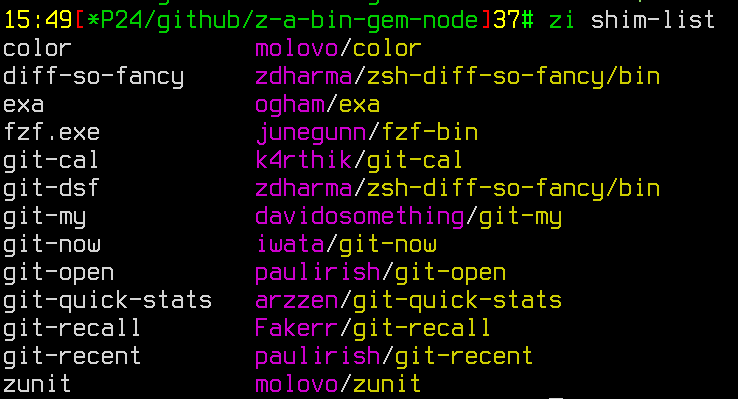
An additional Zinit command is provided by this annex: `shim-list`. It searches for and displays shims
|
||
stored under `$ZPFX/bin`. Example invocation:
|
||
|
||
|
||
|
||
Available options are:
|
||
|
||
| Option | Description |
|
||
| ---------------- | --------------------------------------------------------------------------------------------------------------------------------------------------------------------------------------------------------------------------------------------------------------------------------------------------------------------------------------------------------------- |
|
||
| `-c/--cat` | displays the contents of each of the found shim (unimplemented yet). |
|
||
| `-h/--help` | shows a usage information |
|
||
| `-i/--from-ices` | normally, the code looks for the shim files by examining their contents (shims created by BGN annex have a fixed structure); this option instructs Zinit to show the list of shims that result from the `sbin''` ice of the loaded plugins; i.e., if a plugin has `sbin'git-open'`, for example, then this means that there has to be such a shim already created |
|
||
| `-o/--one-line` | display the list of shim files without line breaks, in a single line, after spaces |
|
||
| `-s/--short` | don't show the plugin/snippet that the shim belongs to, |
|
||
| `-t/--this-dir` | instructs Zinit to look for shims in the current directory instead of `$ZPFX/bin`, |
|
||
|
||
## Cygwin Support<a name="cygwin-support"></a>
|
||
|
||
The `sbin''` ice has an explicit Cygwin support – it creates additional, **extra shim files** – Windows batch scripts
|
||
that allow running the shielded applications from, e.g., Windows run dialog – if the `~/.zinit/polaris/bin` directory is
|
||
being added to the Windows `PATH` environment variable, for example (it is a good idea to do so, IMHO). The Windows
|
||
shims have the same name as the standard ones (which are also being created, normally), plus the `.cmd` extension.
|
||
|
||
### Example<a name="example-6"></a>
|
||
|
||
```zsh
|
||
zinit pack=bgn for firefox
|
||
```
|